Melted Tomatoes: Act Now and Prevent the Winter Blues
For years I’ve argued that the best way to enjoy a garden fresh tomato is to eat it the minute you pick it and let the juice drip down your chin.
And last summer, well, last summer I realized that I was wrong.
That’s not to say that I’ve stopped eating fresh tomatoes like they’re apples. When the first tomato of the season ripens I stand among the towering plants bursting haphazardly from their cages, their wild, twisting limbs laden with green fruit, and I sink my teeth into my long-awaited prize. Then I pass the dripping tomato to Greg who is patiently waiting by my side, beaming with pride. (I’m pretty sure that eating the first garden tomato of the year without your spouse is grounds for divorce, but I’ve never dared to verify it.) It’s my favorite rite of summer: the savoring, the sharing, the reward for months of patience and hard but pleasurable work.
Admittedly, that first bite into pure unadulterated summer is hard to beat. But what if there was a way to make those juicy tomatoes taste even better? Yes, better. And what if that way not only improved on perfection but gave you a means of preserving your treasured harvest long after the first frost settles on your withered tomato vines?
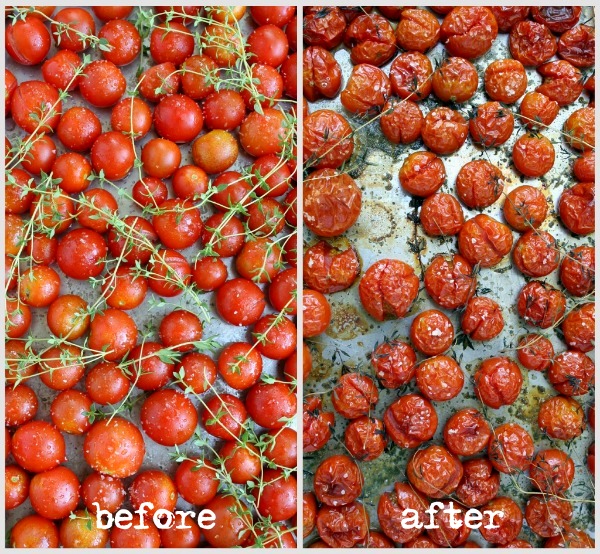
I give you the Melted Tomato, a.k.a. the Roasted Tomato, or as I’ve come to think of it: my winter salvation. Roasting the tomatoes concentrates their immensely satisfying flavors and adds a bonus–a sweet, almost caramel note that you can only get when tomatoes are roasted. I know, I know, I had you at caramel.
Don’t blink or you’ll miss the recipe: Put tomatoes on a pan, drizzle with olive oil, sprinkle with salt, and roast at 375°F until melted. Store leftovers in a jar and cover with olive oil. It’s that quick and that easy. And as Ben Franklin famously said, “An ounce of prevention is worth a pound of cure.” Then when Old Man Winter tightens his grip on you, reach for your melted tomatoes. Toss them with penne pasta and a little garlic. Sprinkle them on a pizza. Or smear them on a slice of crusty bread. They can do more to lift a dour mood than an anti-depressant, vitamin D supplement, or sun lamp.
Melted Cherry Tomatoes
Ingredients
-
Cherry tomatoes
Olive oil
Sea salt
Fresh ground black pepper
Fresh herbs (optional)
Preparation
- Preheat oven to 375°F.
- Place tomatoes onto a rimmed baking sheet.
- Generously drizzle with olive oil.
- Sprinkle with salt and pepper.
- Place stems of fresh herbs over the tomatoes. (Tarragon and thyme are my favorites.)
- Roast until tomatoes look limp and melted, about an hour.
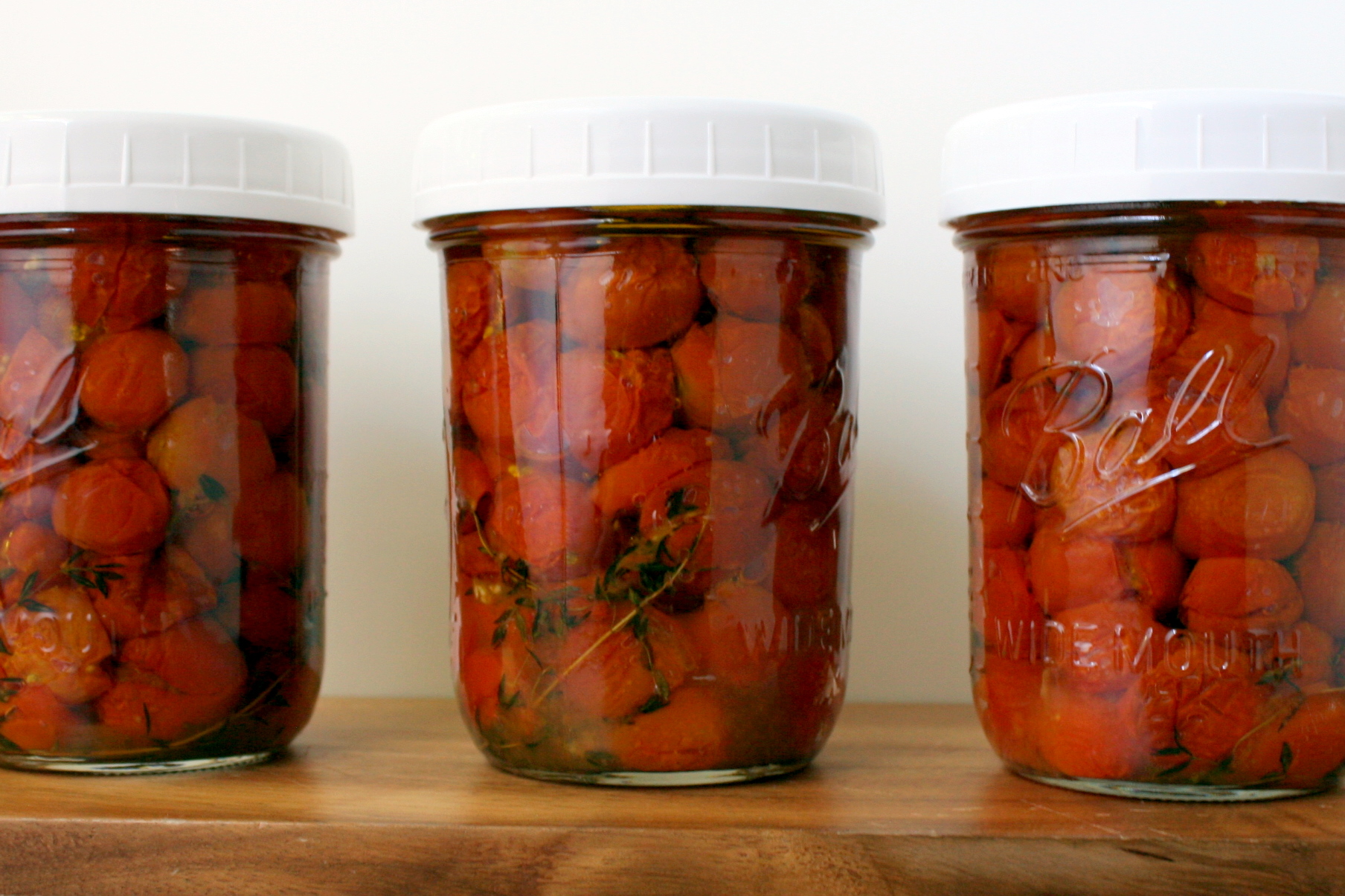
- Place hot tomatoes into a sterilized jar leaving at least an inch of head space.
- Cover tomatoes with olive oil so that no part of the tomato is above the oil line.
- Refrigerate until ready to use*.
*note: The olive oil will solidify in the fridge. Scrape it back, take out as many tomatoes as you need, and smooth the oil back over the tops of the remaining tomatoes. Keeping the tomatoes covered with the oil is the secret to their extended shelf life.
Apricot Preserves with Vanilla Beans and Gewürztraminer

Early Saturday morning Greg and I hit the road and made our way to Michigan in search of fruit–fresh, fresh, fruit. We make the trip every year around this time just as the blueberry season goes into full swing. Two hours later we were headed back to Chicago with eighty pounds of fruit, including thirty pounds of giant blueberries and twenty-five pounds of perfect peaches. The inside of our car smelled like an orchard, and we gorged ourselves on blueberries until we hit the Chicago Skyway.
As we unloaded the car, which of course took several trips (yes, eighty pounds), the reality of my situation began to sink in–my weekend was booked. I would be spending the next two days at the stove hovering over simmering pots of preserves.
I blame Christine Ferber, a.k.a. the Fairy Godmother of Jams and Jellies. Christine’s cookbook, Mes Confitures, arrived two weeks ago, and I have been dreaming of jam since the day I cracked the cover. Alas, my fruity dreams turned into something more accurately described as a long, sweaty nightmare. By Monday, the floor was sticky with sugary syrup, my legs ached, and I had run out of jars, but not out of fruit. In my darkest hour, only one thing kept me going: every batch of jam I made from that damn book was AMAZING!
At last, all our Michigan fruit has been preserved in one way or another. (We froze most of the blueberries.) And all week Greg and I have been sampling jams, jellies, preserves, and conserves at breakfast. After extensive, ahem, testing, two batches of these not-too-sweet vanilla bean scones (our blank canvas), and plenty of oohing and aahing, we are ready to declare our favorites of the season. My new love is the apricot preserves shown here. (Greg’s pick is a peach and almond conserve, which I’ll post next week.) The combination of apricots and vanilla, a combination I’ve never thought to try, is positively addictive. I was making excuses to go to the kitchen just so I could spoon some into my mouth. Classy, eh?
Try this recipe with the freshest apricots you can find, and you’ll be hooked too.

Apricot Preserves with Vanilla Beans and Gewürztraminer
Adapted from Christine Ferber‘s recipe in Mes Confitures.
Ingredients
-
3 pounds of apricots (about 2 quarts)
4 cups granulated sugar
1 lemon, juice and zest
1 orange, juice and zest
2 vanilla beans, split lengthwise
9 ounces dried apricots
9 ounces Gewürztraminer wine
Preparation
- Rinse the apricots. Slice them in half to pit them.
- Combine the apricots, sugar, citrus zests and juices, and vanilla beans in a bowl. Refrigerate and let macerate for an hour.
- Pour the contents of the bowl into a non-reactive pan and bring to a simmer. Pour back into the bowl. Cover and refrigerate overnight.
- Cut the dried apricots into little sticks about 1/8-inch wide. Put them in a bowl and cover with the wine. Refrigerate overnight.
- The next day, pour the fresh apricot mixture into a sieve. Put the collected syrup and vanilla beans in a large sauce pan and bring it to a gentle simmer. Skim and continue cooking on high heat until concentrated. If you have a candy thermometer, boil until it reaches 221°F. (Christine removes the apricot skins while she is straining them. This will only work if your apricots are very firm. I left the skins on–it saves time and no one that tasted the jam even noticed them.)
- Add the re-hydrated apricots and the apricot halves to the syrup. Return to a boil for about ten minutes, stirring gently and skimming if necessary.
- Remove the vanilla beans. Cut them into pieces and distribute them among the prepared jelly jars.
- Process the jam immediately using your method of choice. If you’re a canning novice, The National Center for Home Food Preservation is a great resource: Processing Jams and Jellies.

Makes about 8 cups.
 Want more fruity, summery goodness in a jar? Try some Strawberry Jam with Black Pepper and Tarragon or Fig Preserves.
Do you happen to know someone who’s discovered a bag of zucchinis on their front porch? As the legend goes, there are parts of the world where zucchini is so plentiful that growers are driven to surreptitiously and anonymously bestow bags full of the green beauties on the stoops and porches of their friends and neighbors. I’ve read lots of stories like this, but alas, have never had such good fortune–either as the grower/giver or the receiver. I always seem to have more zucchini recipes in my “must try” folder, than I do zucchinis:
-
Grilled Zucchini and Summer Squash Salad with Basil-Parmesan Dressing
Coconut Red-Lentil Curry
Buttermilk Summer Squash Soup
Zucchini Gratin
Zucchini Ricotta Cheesecake
Zucchini, Goat Cheese and Bacon Tart
Grilled Zucchini Flatbread
We grew a lot of zucchini in our garden when I was a kid. Sadly, I didn’t love it then the way that I do now, probably because it was cooked (a lot!) in only one of three ways: sliced thick, battered and pan fried, stuffed with tomatoes and ground beef and baked with mozzarella, or shredded for zucchini pancakes. Mom baked the occasional zucchini quick bread too, but when we were faced with more zucchinis than we could eat and refused to eat another zucchini pancake, mom didn’t put them on the neighbor’s porch. Instead, she started hiding zucchini in things like chocolate cake or her “apple” pie that didn’t contain a single apple. Mom was a tireless prankster and took great pleasure in watching an unsuspecting someone, who proclaimed to hate zucchini, tear into a piece of that pie.
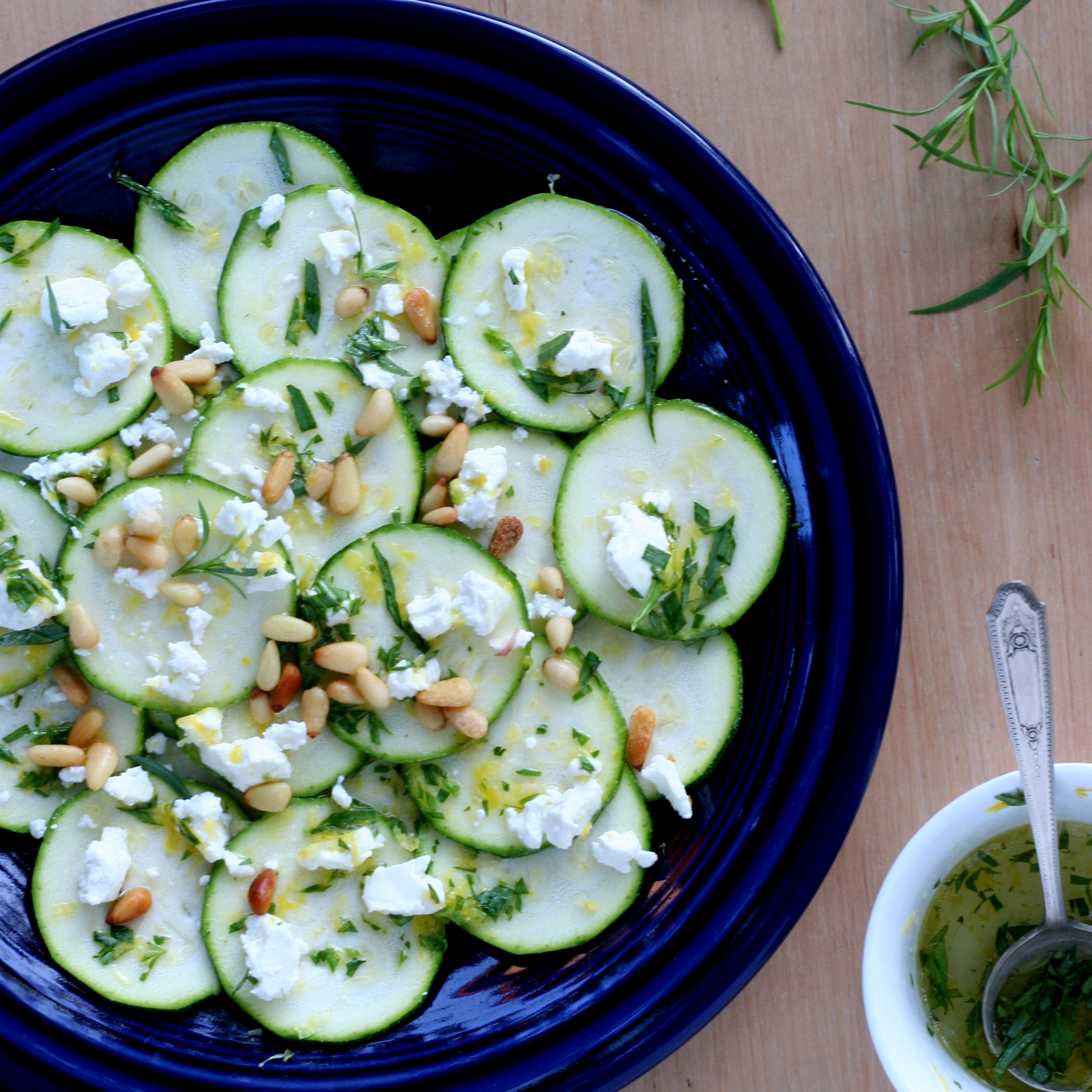
Now that I know there are endless ways to deliciously prepare zucchini, I dream of finding a bag of them on my porch. After years of battling the squash vine borer in our garden, Greg and I have given up on growing squash, forcing me to begrudgingly tote them home from the farmers market a few at a time. My latest zucchini fetish–likely inspired by our hot and humid summer weather–has been to serve it raw. The zucchini salad pictured above can be a satisfying main course when served alongside a hearty slice of bread. It’s also an eye-catching, but simple starter course.
If you happen to know someone with too much zucchini on their hands, please send them my way. My list of “must try” zucchini recipes is growing fast.
Zucchini Salad With Tarragon and Lemon
- Inspired by Clotilde Dusoulier’s recipe in House Beautiful Magazine.
Makes 2 dinner salads or 4 starters.
Ingredients
-
2 small zucchinis, about 1 pound
2 ounces chèvre, crumbled (Feta is nice too.)
1/2 a lemon, zest and juice
2 tablespoons white balsamic vinegar
3 tablespoons olive oil (the nicest you have on hand)
1 tablespoon fresh tarragon leaves, roughly chopped
2 tablespoons pine nuts, toasted
coarse, flaky sea salt (like Maldon)
Preparation
- Cut zucchini into 1/8-inch thick slices and arrange on plates in a thin layer.
- Sprinkle with crumbled cheese.
- Whisk together lemon zest and juice, vinegar, olive oil, chopped tarragon, and a pinch of salt.
- Drizzle the vinaigrette over the zucchini and cheese.
- Finish with toasted pine nuts and flaky salt.
Bob-Á-Go-Go Energy Bars
Road trip!
St. Louis here we come. Okay, it’s not the most, ahem, glamorous destination, but I’m a firm believer that life is all about the journey especially when the journey involves food.
A certain chaos erupts in the hours leading up to our departures and no amount of pre-planning can change that. I’ve tried, for Greg’s sake. “Why do we always have to leave this place like we’ve been shot from a cannon?” he asks as he scurries from room to room gathering water bottles and misplaced phone chargers. I’ve learned to act as though it’s a rhetorical question, because those are the kind of questions best left unanswered when you are about to spend a lot of time in the car with the person doing the asking.
I don’t actually mind the chaos though I don’t mention that either. Greg does the driving–the real work of the road trip–and for that I am oh so grateful. Once safely nestled in the car, my job is to navigate and feed and entertain the driver. It’s a nice gig, right? The inevitable flurry of activity around our departure provides a stark contrast to relaxing in the car for hours on end, making me feel as if I’ve earned the right to sit on my bum.
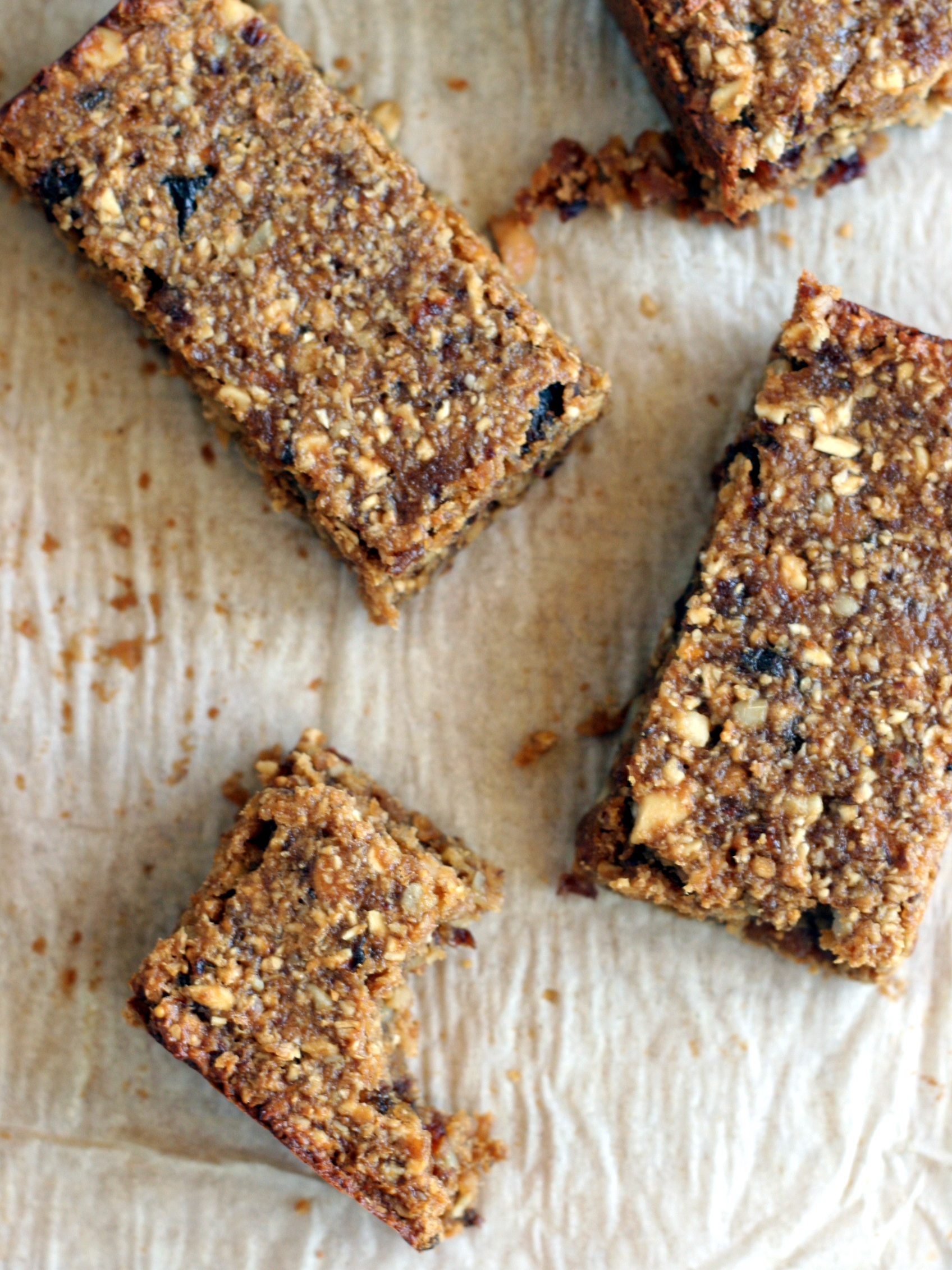
My favorite way to perpetuate the chaos is to experiment in the kitchen the day before we’re set to leave. (Yes, Greg finds that maddening until he’s somewhere in the middle of I-80 noshing on a homemade goodie.) When I should be tracking down that darn purse that matches my sparkly black go-out shoes, the one I haven’t seen since the last wedding we went to a year ago, I’m instead pouring over notes for a new granola bar. I’m suddenly over my go-to granola bars, the ones I can make without a recipe or an oven, the ones that Greg loves even though we both agree they’re a bit too sweet at times. I wanted a slightly savory bar that would do double duty as both a filling snack and a breakfast bar. These tasty treats fit the bill. They pack a punch with enough protein to keep you going from breakfast until lunch without a single hunger pang.
There’s a lot more I wanted to say about our upcoming adventure and all the yummy treats I prepared for the road and my lovable driver, but my Bob-Á-Go-Go Bars are ready for wrapping and packing. And I still haven’t found that purse.
Bob-Á-Go-Go Energy Bars
Makes 18 bars.
Ingredients
-
2 cups unsweetened puffed cereal (wheat or kamut)
1/2 cup roasted peanuts
1/2 cup raisins
1/2 cup (4 ounces) dried figs
1/3 cup wheat germ, toasted
2 cups oatmeal
1/3 cup sunflower seeds
1/2 cup date molasses (or honey or maple syrup)
1/2 cup maple syrup
1/2 cup unsweetened applesauce
1/2 cup peanut butter
3/4 teaspoon salt
1/2 teaspoon cinnamon
Preparation
- Preheat oven to 350°F.
- Line a 9×9″ square cake pan with parchment paper.
- Combine the puffed cereal, peanuts, and dried fruit in a food processor and pulse until the mixture is coarsely chopped.
- Add the wheat germ, oatmeal, and sunflower seeds. Pulse once or twice to combine. Add remaining ingredients and pulse until thoroughly mixed. It will resemble a thick, coarse paste.
- Using a lightly oiled large spatula or your hands, evenly compress the mixture in the prepared pan.
- Bake 30-35 minutes, until golden brown and pulling away from the parchment paper at the edges.
- Allow to cool in the pan for 30 minutes.
- Cut the slab into a 6×3 grid while still warm.
- When bars are completely cool store in an airtight container and refrigerate.
Nutrition summary: calories: 205, total fat: 7.8g, saturated fat: 1.3g, carbohydrates: 30.7g, fiber: 3.2g, protein: 5.9g

My second favorite granola bars: Chewy Blueberry Almond Granola Bars.
My husband Greg was a man with a limited palate when we first began dating ten plus years ago. And if the truth must be told, my own palate was decidedly more akin to Lou Malnati’s Pizza than The French Laundry. But what Greg lacked in breadth of gastronomic experience, he made up for with a dogged willingness to try anything once. That was just one of the many reasons I fell in love with him, and it was a big one. Food had always been front and center in my world; I couldn’t share my life with someone who was apathetic about what was on their plate.
Over the years he’s picked and panned his way through stinky cheeses, pickled eggs, and lingua agrodolce (sweet and sour calf’s tongue). He’s comfortable knowing that his arugula salad is punctuated with foraged greens from our yard–greens like yellow wood sorrel and lambs quarters that we once considered as weeds. He’s not surprised to see a pansy sitting on top of his salad. He’s made friends with a whole fish that stared at him from the grill that it just barely fit on. He loves ahi poke. And recently he tried and liked conch pistol (known to have, ahem, aphrodisiac effects) pulled from a live conch. He prefers multi-grain bread with quinoa and millet: “the crunchier, the better.” Jicama, kolhrabi, mustard greens: “where have they been all my life?”
Greg’s list of tried and liked foods is a long one that continues to grow. And it’s a list that thankfully includes beets though they were a hard-won addition. A predictable pattern has emerged over the years. I receive (orphans from my neighbor’s CSA veggie box), make (yup, I’m always game for an experiment stoveside), buy (who can resist a packet of guava paste the first time they see it?), or order (fried pig’s ear from the Purple Pig anyone?) something. Greg tries it. And usually, he likes it. Mike Likes it. It is a rare occasion when he pans something. And when he pans something I love, like beets, I take it hard, very hard.
Greg agreed to try beets a couple of years ago. First up, a salad. I roasted the beets (It’s my very favorite way to cook them, because it brings out their sweetness.). I sliced them with care and partnered them with creamy mascarpone, toasted walnuts, and a generous drizzle of aged balsamic. I was downright giddy with anticipation as he brought the fork to his mouth.
“It’s okay,” he finally said. His face said it was a failure before he even spoke.
“Okay?” I asked in disbelief.
“Yah, I mean, I’ll eat it, but I don’t know that I’d want to have it again anytime soon.”
I couldn’t hide my disappointment–I L-O-V-E beets.
“Would you consider trying them again sometime if I prepared them differently?”
“Sure,” he said though I was certain it was only to erase the pitiful look on my face.
But I went with it, and a few weeks later we had them again in a tart. This time I got a “not bad”, which I knew was better than an “okay” but still not the reaction I craved.
Fast forward to Christmas 2010 at sister Annie’s house. We’re gathered around the island in her kitchen as she’s pulling treats from the fridge to tide us over until dinner. Out came a quart jar of my very favorite pickled beets. Annie makes the best pickled beets I’ve ever tasted, and this beet lover has tried her share. I’d never offered her beets to Greg. I mean, why waste something so precious on someone who can’t appreciate it.
So Annie offers Greg a beet. He takes it. I watch, miffed because there’s one less for me, and I’m certain I know how the story ends. I watch for the “they’re okay” look to appear on his face, because he probably wouldn’t say as much to my sister. And then the unexpected happens. It was like the scene from Dr. Seuss’s Green Eggs and Ham when the man finally tries Sam’s green eggs. Greg’s face lights up brighter than the Christmas tree and he says, “these are awesome.” Not good, not great, not okay–“awesome.” Then he delivers the zinger, “how come you don’t make beets that taste like these?”
My response to his question isn’t fit to share here. Let’s just say it wasn’t my best moment. But I got over it quickly when I realized the implications: the man I love had finally learned to love beets. Now, six months later that same man loves this beet purée…almost as much as he loves Annie’s pickled beets.
Blissful Beet Purée
Adapted from Skye Gyngell‘s A Year in My Kitchen.
Ingredients
-
1 pound beets
1 clove garlic
1 tablespoon grated horseradish
1/3 cup Greek yogurt
12 mint leaves
1/3 cup cilantro
1 teaspoon Roasted Spice Mix
1 tablespoon olive oil
2 tablespoons aged balsamic vinegar
Preparation
- Preheat oven to 400°F.
- Wrap beets in foil and roast for 30-60 minutes depending on their size. If they yield slightly when pressed, they’re done. Remove the beets from the oven, let cool, and peel.
- Combine the roasted beets and all remaining ingredients in a food processor or blender. Whirl them together until you have a very smooth purée. Season with salt and adjust the flavors to your taste. When I’m feeling a little spicy, I double the amount of horseradish.
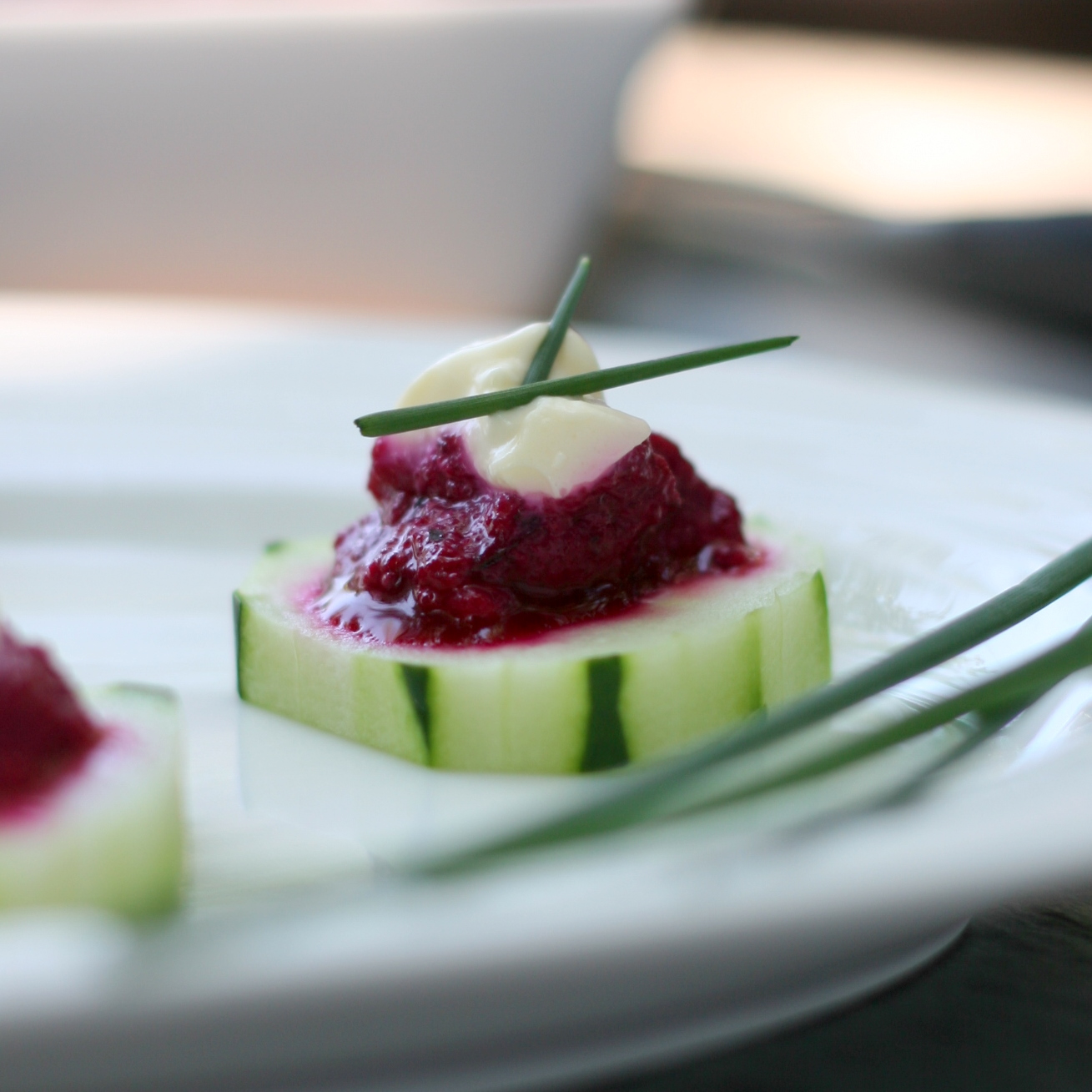
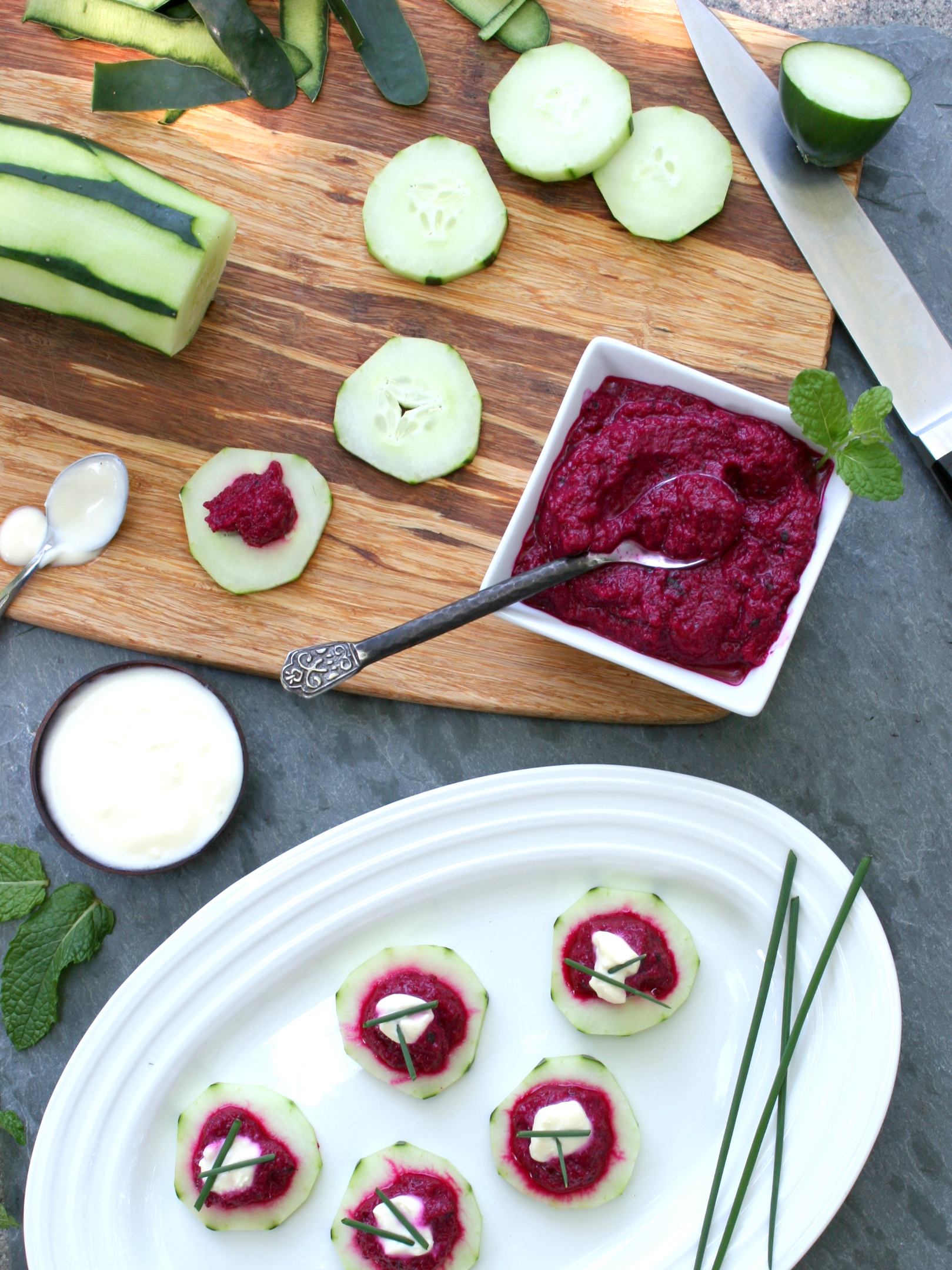
- Enjoy the purée alongside some salmon or your favorite egg dish, with slices of toasted pita, or my favorite way (pictured above) — perched on top of fresh sliced cucumber and finished with crème fraîche and chives. It’s summertime in a single bite.
 I’ll bet this pretty beet purée would be a perfect partner for Smoked Mackerel Mousseline.
Strawberry Jam with Black Pepper and Tarragon

Strawberries and tarragon are one of my favorite summer food pairings. A friend introduced me to the transcendental combination a few years ago in a simple salad:
sliced strawberries + tarragon + balsamic vinegar = perfect summer.
It’s one of those indelible food moments for me that doesn’t fade with time.
So why in the heck did I wait so long to bring them together in a jam?
Because I usually gorge myself on fresh berries leaving too few for jam making.
Because I’ve never found a reliable pectin-free strawberry jam recipe that didn’t involve boiling the beautiful berries until they were lifeless.
Because…well, does it really matter why? I’ll skip to the end, to the present: this is the best jam I’ve ever conjured up in my kitchen, which given my affinity for all things preserved, says a lot.
This jam is delicious on whole grain toast, a still-warm hunk of French bread, and these crackers. It’s a natural with peanut butter. And it’s better than honey with a piping hot biscuit. But midway through my second jar in five days I discovered the perfect mate for my muse: cheese. We had it with our favorite Pleasant Ridge Reserve, though I suspect it’s equally yummy with a mild white cheddar. I’m planning to try it soon, very soon, with Gruyère in these irresistible grilled cheese sandwiches.
Run to the market, grab a couple quarts of the season’s last strawberries and a fistful of fresh tarragon and conjure up your own batch of bliss today.

Strawberry Jam with Black Pepper and Tarragon
Inspired by Cathy Shambley‘s version of a Christine Ferber recipe from Mes Confitures.
Ingredients
-
2 quarts strawberries (about 3 pounds)
4 ½ cups granulated sugar
1 lemon, juice and zest
2 tablespoons tarragon, roughly chopped
1 teaspoon black pepper, coarsely ground (about 40 peppercorns)
Preparation
- Rinse the berries. Slice them in half or in quarters depending on size.
- Combine the berries, sugar, and lemon juice and zest in a bowl. Cover and let macerate overnight.
- The next day, put the berry mixture in a large sauce pan and bring it to a gentle simmer. Stir occasionally until the sugar dissolves then remove from heat.
- Using a sieve, separate the berries from the juice.
- Return the liquid to the pan. Bring to a boil and cook on high until concentrated. If you have a candy thermometer, boil until it reaches 221°F. (This took about 20 minutes.)
- Add the reserved strawberries, tarragon, and pepper to the syrup. Allow the mixture to boil for about five minutes.
- Process the jam immediately using your method of choice. If you’re a canning novice, The National Center for Home Food Preservation is a great resource: Processing Jams and Jellies.
Makes 6 cups.
 If you’re bitten by the jam-making bug this summer, consider trying some mulberry jam or fig preserves.
Rhubarb Schnapps: Another Reason to Love Nigella
…cooking, we know, has a way of cutting through things, and to things, which have nothing to do with the kitchen. This is why it matters.
Sometimes…we don’t want to feel like a postmodern, postfeminist, overstretched woman but, rather, a domestic goddess, trailing nutmeggy fumes of baking pie in our languorous wake.
Nigella Lawson, How to Be a Domestic Goddess
My love affair with Nigella Lawson began nearly a decade ago. Maybe it was the way she spoke–her lilting voice so beautifully accented and emanating from a sultry set of lips that even Angelina Jolie would envy. Maybe it was watching her whip up a chocolate fudge cake in a little black dress, infusing the scene with equal parts of wit and reassurance, a pinch of whimsy and an overtone of sensuality. How could I not fall for a woman who used the words pleasure, forever summer, and goddess in the titles of her irresistible cookbooks?
I’ve learned so much from Nigella over the years. She gave me the confidence to pickle a plum and make marmalade with grapefruits instead of oranges. She reminded me of the pleasure of cooking for one. She showed me that cake baking is “a great culinary scam” because “…it implies domestic prowess…” but can often be accomplished in less than thirty minutes. Thanks to Nigella I always have vanilla sugar on hand. And most recently she taught me that perhaps the best way to enjoy rhubarb, and arguably the best way to preserve it, is to, well, drink it.
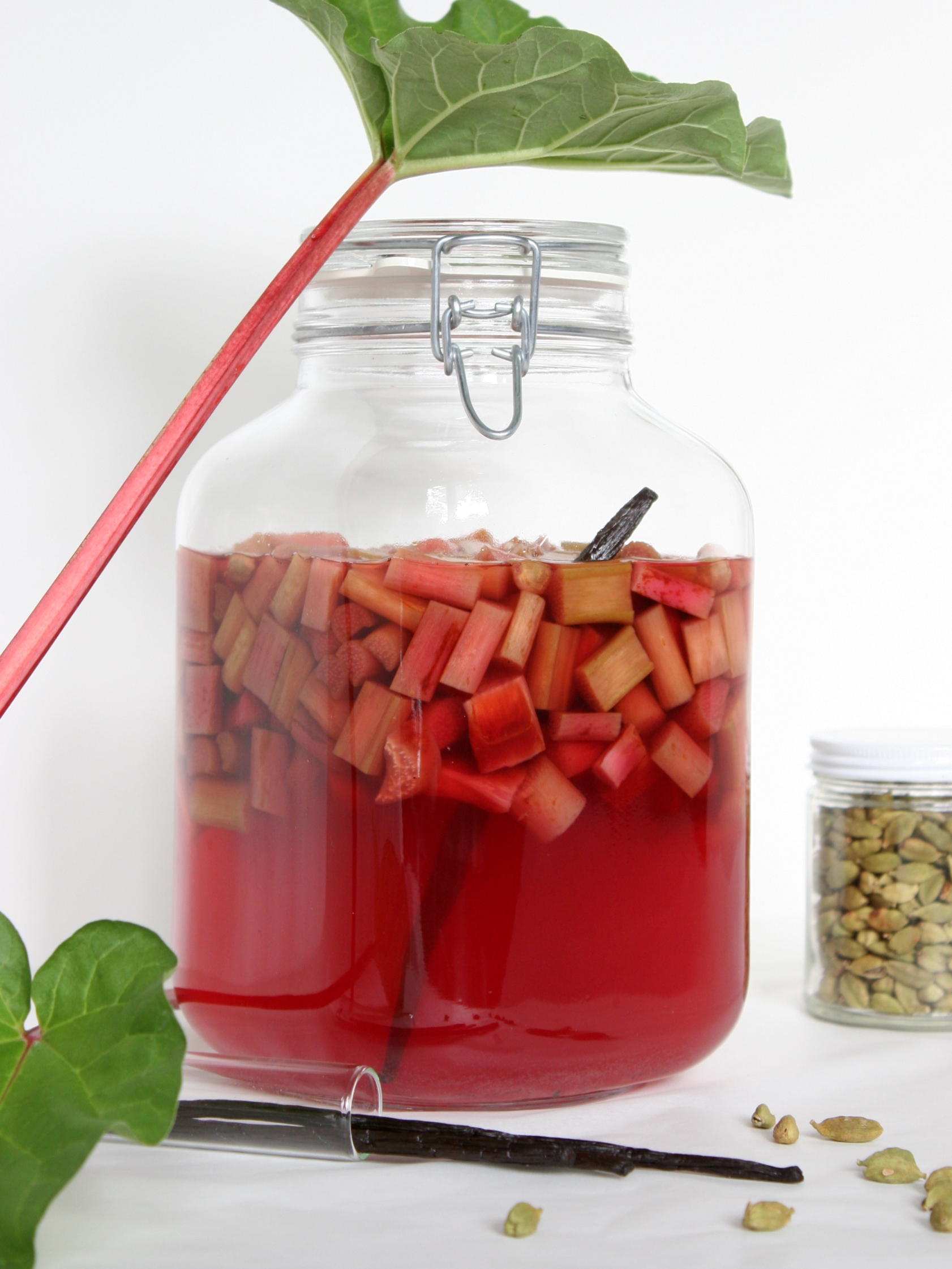
The inspiration for Nigella’s Rhubarb Schnapps, which omits the cardamom and vanilla that I used in mine, came to her in the middle of the night. Such unabashed, all-consuming fervor for food is what I love most about her. For Nigella, and for me, food is a “slavering” passion. We cook first and foremost because we love to eat or, as is the case here, drink. The only drawback to this recipe is that you must wait six weeks before you can enjoy it. But as the rhubarb season wanes, I can look forward to sipping my schnapps on a hot August night. Thank you Nigella.
Rhubarb Schnapps
Adapted from How to Be a Domestic Goddess
Ingredients
-
1 ½ pounds of rhubarb, cut into 1″ pieces
1 cup granulated sugar
1 vanilla bean, slit down the side
8-10 green cardamom pods
1 liter of vodka (Don’t bother buying the good stuff.)
Preparation
- Place all ingredients in a large jar.
- Put the lid on and shake well.
- Store the jar in a cool, dark place for six weeks.
- Shake the jar every other day for the first month.
- Strain into a clean bottle.
- Serve it neat and chilled. Or over ice with a little sparkling water. Or mix a little with some champagne. Enjoy!
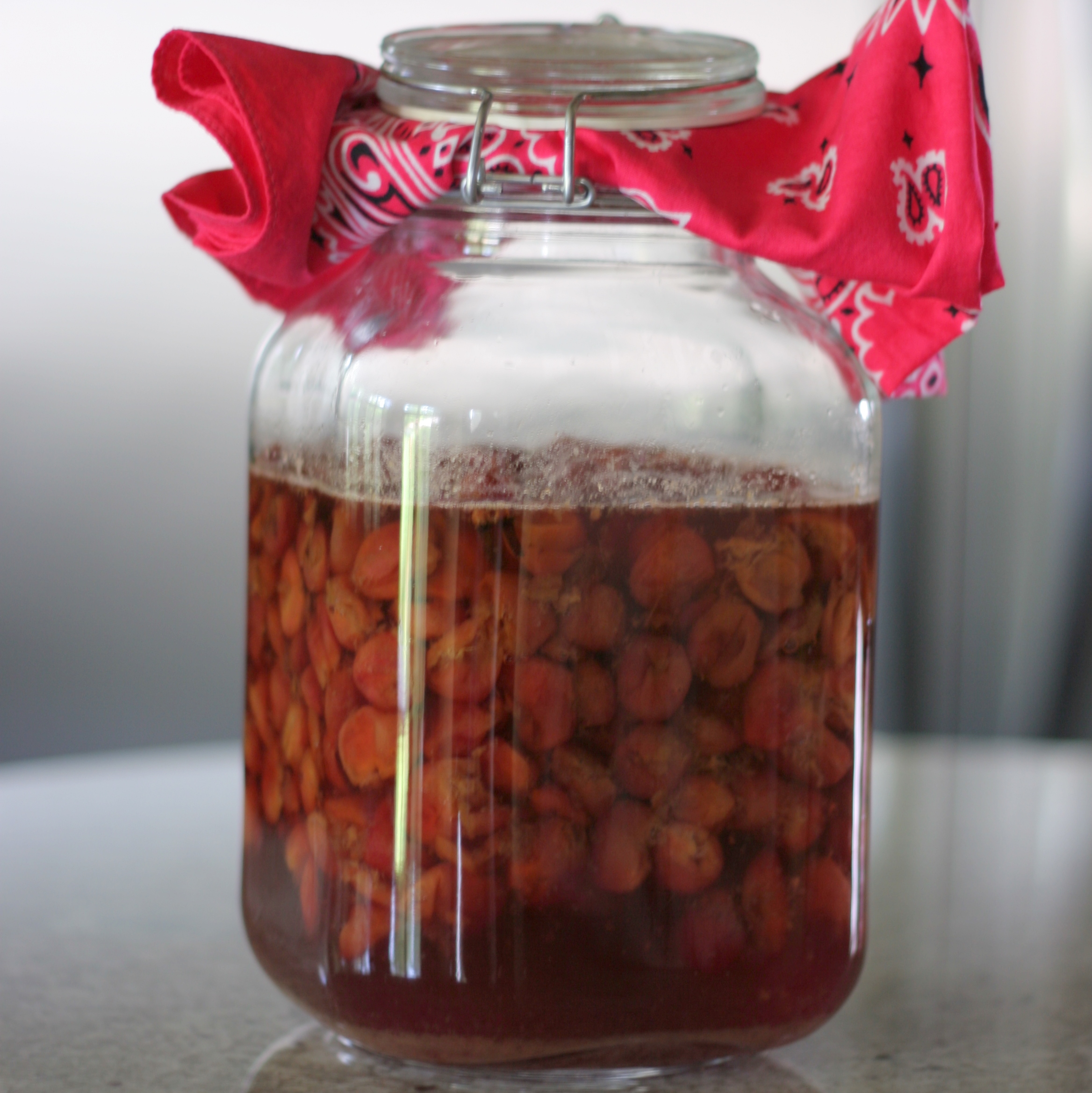
 Here’s another boozy treat to try this summer: Cherry Bounce.
Olive Oil Cakes With Spring Pea Puree

As you’ve probably already guessed, this isn’t a “quick, one-pot wonder”–this is a fussy recipe. That said, fussy doesn’t necessarily mean difficult. There are no tricky techniques or exotic ingredients involved, but the steps require a bit more care than simply tossing things about in a bowl. Don’t be intimidated. If you can bake cupcakes, you can make these lovely cakes. And while they aren’t the sort of thing to whip up when you’re pressed for time, they are the perfect little something for a special meal. In my case, it was just a quiet dinner in the yard with my hubby.
I often find my culinary inspiration outside the kitchen. This time I found it in the lobby of a 1960s office building where I was spending two days in an Illinois food service sanitation manager training course (FSSMC). On a study break and desperate for a distraction from pathogens and hand washing techniques, I reached for a copy of Time Out Chicago. As if by fate, I turned immediately to the page featuring these delightful olive oil cakes created by Crystal Chiang, the pastry chef at Owen & Engine in Chicago. Those cakes captured my heart and my imagination. Two days and a certification exam later, my husband Greg and I enjoyed my version alongside a simple arugula salad. Chiang doesn’t use Sriracha sauce in her recipe, but it really brightened up the flavors and was a nice complement to the sweetness of the dish. Fussy bits and all, the cakes still took less than an hour from start to finish.
Sometimes I like fussy. I like getting a bit lost in the details of preparing a dish that demands my full attention. It can be the perfect antidote for a lousy day. And as someone who admittedly says “I love you” with food, well, quick and easy isn’t always the most meaningful way for me to say it. Sometimes a little fussy says “I love you and you’re worth it.”
Olive Oil Cakes With Spring Pea Puree
Adapted from Crystal Chiang’s recipe at Time Out Chicago.
Ingredients
1 cup spring peas
2 tablespoons water
2 tablespoons sugar
½ cup heavy cream
2 oz. Pleasant Ridge Reserve cheese (Or substitute Parmesan or Manchego.)
1 egg
2/3 cup sugar
½ cup olive oil
½ cup whole milk
Zest of ½ of lemon
¾ cup all-purpose flour
½ teaspoon baking powder
¼ teaspoon baking soda
½ teaspoon kosher salt
12 sage leaves
canola oil
salt
Sriracha Hot Chili Sauce

Preparation

- Preheat oven to 350°F.
- Make the pea puree: Blanch (about two minutes) or steam peas until tender. Strain the peas and place them in a blender or food processor along with 2 tablespoons of sugar and water. Puree and set aside. Add more water a tablespoon at a time if needed.
- Bake the cheese crisps: Line a sheet pan with parchment paper or a Silpat. Thinly slice the cheese and cut into 1″ x 2″ rectangles. Place the cheese on the sheet pan and bake until golden brown, about 7-8 minutes.
- Make the olive-oil cakes: Lightly grease the cups of an oversized muffin pan or line with paper inserts. Whisk the egg and sugar together. Add the olive oil, milk and lemon zest, whisking until thoroughly combined. In a separate bowl, sift together the flour, baking powder, baking soda and salt. Whisk the dry ingredients into the egg mixture until just combined. Divide the batter among six muffin cups. Drop a slightly rounded tablespoon of pea puree into the center of each cake. Bake the cakes for 17–20 minutes, until golden brown and the center of the cake springs back when lightly pushed.
- Fry the sage: Heat the canola oil in a small, deep sauce pan. Fry sage leaves until crisp (a few seconds). Transfer the leaves to a paper towel–lined plate. Lightly season the leaves with salt.
- Make the pea cream: Combine the remaining pea puree with the heavy cream. Refrigerate until the cakes are ready for assembly.
- Assemble the cakes: Remove the warm cakes from the pan and carefully remove the paper wrapper if using. Spread the pea cream on a small plate. Turn the cake upside down on top of the cream. Garnish each cake with two fried sage leaves and a cheese crisp. Dot the serving plate with Sriracha sauce. Makes 6 cakes.





 Bob Vivant